
Labs in general are playgrounds of curiosity and Innovation. They give students the freedom to explore ideas, test assumptions, and build their own understanding. Young minds grow faster when they experiment, fail, learn, and try again. An EV Lab not only supports this process but also inspires purpose, creativity, and a deep interest in shaping the future of clean transportation.
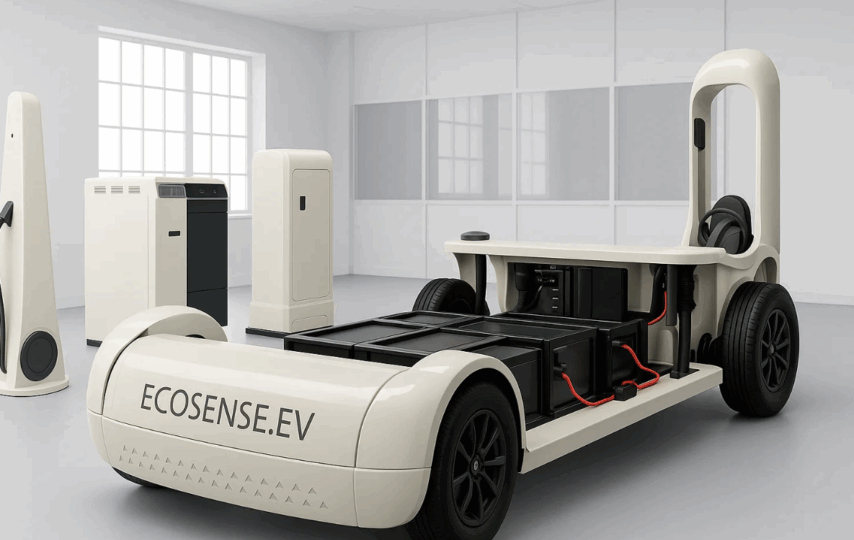
An Electric Vehicle Lab gives students a space where theory meets practical engineering. They explore traction batteries, traction motors, power electronics, and chargers working together. Students move from passive learning to active problem-solving. This transformation sets the foundation for becoming future-ready engineers.
Turning Curiosity into Practical Understanding
Most students learn EV concepts through lectures and textbooks. However, knowledge becomes meaningful only when learners see systems working in real time. An EV Lab bridges this gap by enabling students to test ideas on real components and observe their behaviour.
When a student analyses control algorithms for motor control, adjusts the parameters of a power electronics converter, or becomes hands-on with batteries, they build strong technical intuition. This hands-on process deepens understanding and boosts problem-solving approach.
Such active learning strengthens curiosity. It encourages students to ask questions, explore alternatives, and understand concepts beyond theory.
Encouraging Innovation Through Experimentation
Innovation grows when students have the freedom to test, break, rebuild, and improve. EV Labs creates that environment. Learners experiment with different motor control strategies, battery chemistries, drive cycles, and charging approaches. They see the effect of each change and learn to reason through results.
Through experimentation, students tackle real engineering problems such as:
- Improving EV range with better Battery Management Systems
- Increasing motor efficiency under varying load conditions by tweaking controls
- Enhancing battery life using methods like the Flexible Power Point Tracking Algorithm
- Reducing thermal stress in power electronics
- Strengthening safety in high-voltage systems
Each experiment sharpens creativity and analytical thinking. Students learn to view challenges as opportunities for innovation. This mindset becomes essential when they move into research roles or join EV design teams.
Building Purpose by Solving Real-World Challenges
Many students want to contribute to society but struggle to find direction. EV Labs give them purpose by linking technical skills to sustainability goals. Young engineers see how their decisions affect system efficiency, grid stability, and clean mobility outcomes.
When they optimize a BMS algorithm, they directly improve cell balancing, thermal regulation, and cycle life. When they fine-tune a motor controller, they reduce switching losses, enhance torque response, and lower overall energy consumption. These technical improvements translate into better vehicle range and fewer emissions.
Purpose becomes clearer when students observe measurable changes in data logs, efficiency curves, and thermal profiles. They understand that engineering choices influence environmental impact at a system level.
Enhancing Industry Readiness and Career Growth
The electric vehicle sector is expanding rapidly. Companies prefer engineers who understand testing, validation, simulation, and system-level integration. Students trained in an EV Lab gain practical exposure that makes them industry-ready from day one.
They learn to:
- Operate motor controllers and power electronics
- Understand battery management systems and communication protocols
- Analyze cycling data for performance and ageing
- Work with real-time simulators
- Study AC and DC charging systems
- Handle safety in high-voltage environments
Such skills make students valuable candidates for internships, research projects, and full-time roles. Engineers with EV Lab experience perform better in technical discussions and adapt quickly to industrial setups.
Fostering Collaboration and Team-Based Learning
Electric vehicles involve multiple engineering domains. Students must understand electrical, mechanical, electronic, and software elements. EV Labs encourages teamwork by bringing learners from different specializations together.
Collaboration helps students exchange ideas, test assumptions, and learn from diverse perspectives. This environment mirrors how modern EV companies operate. Students develop leadership, communication, and project management skills through group activities.
Team-based learning improves productivity and strengthens innovation culture inside institutions.
Supporting Research, Projects, and Entrepreneurship
EV Labs act as incubation spaces for new ideas. Students can work on final-year projects, prototypes, and research publications with real systems. Many institutions see students developing smart chargers, efficient motor control strategies, battery analytics tools, and innovative EV safety systems.
Some students even convert their major academic project into startups. The EV Lab becomes the starting point for an entrepreneurial journey. With proper guidance these students can contribute to economical growth or country’s growth.
The research culture built within these labs accelerates technological advancement and academic excellence.
Conclusion
EV Labs are essential innovation ecosystems within educational institutions. They fuel curiosity, build purpose, and nurture the mindset required for electric mobility. With hands-on experiments, collaboration, and real-world problem-solving, these labs prepare students for the fast-evolving EV industry.
By investing in an Electric Vehicle Lab, institutes empower young engineers to become innovators who will shape the future of clean and sustainable transportation.