
Reaching the 1 million mark is a significant milestone for any business. However, that is exactly when the shift happens: from survival mode to a structured path for growth. The next steps for growing from a $1 million e-commerce business to a $10 million one require a strong business plan that measures and aligns your further course of action through various digital channels.
Digital channels are a great way to drive growth for your small-scale business; in today’s world, it is difficult to achieve consistent growth without utilising them. In this roadmap, we will discuss exactly that: how to create a strong foundation to grow your business by implementing digital strategies.
Building a business plan for sustainable growth:
Start with clear objectives:
It is needless to say that your vision forms the core of every business decision you make for your D2C brand, making it important for you to define your goals clearly to determine the actions you need to take to achieve them and grow your business. If you aim to achieve a revenue of $10 million in the next year, break it down into biannual, quarterly, and monthly targets.
This can help you determine the average order value, marketing budget, and retention rates you need to achieve to reach your goals. Set a clear path to follow to scale the business; it makes targets much easier to accomplish.
Know all relevant metrics:
Once you have a business plan, the next step is to determine all the metrics you need to track and achieve. A few important KPIs (Key Performance Indicators) include Average Order Value (AOV), Customer Acquisition Cost (CAC), Conversion Rate, Customer Lifetime Value (CLV), and Customer Retention Rate.
Build systems around these metrics to review and analyse them weekly or monthly. You can also use a CRM dashboard to help with it for a more effective result.
Build your strategy:
With defined goals and metrics set, the natural next step is to build a strategy that gives your small-scale e-commerce business a competitive edge. Determine what sets you apart from your competitors and keep that at the centre of your marketing strategy. Also, ensure that all your marketing material uniformly communicates this USP to your audience.
Turning a small-scale business into a scalable brand:
There are many efforts you can take to grow your business. Let’s check out what some of them are:
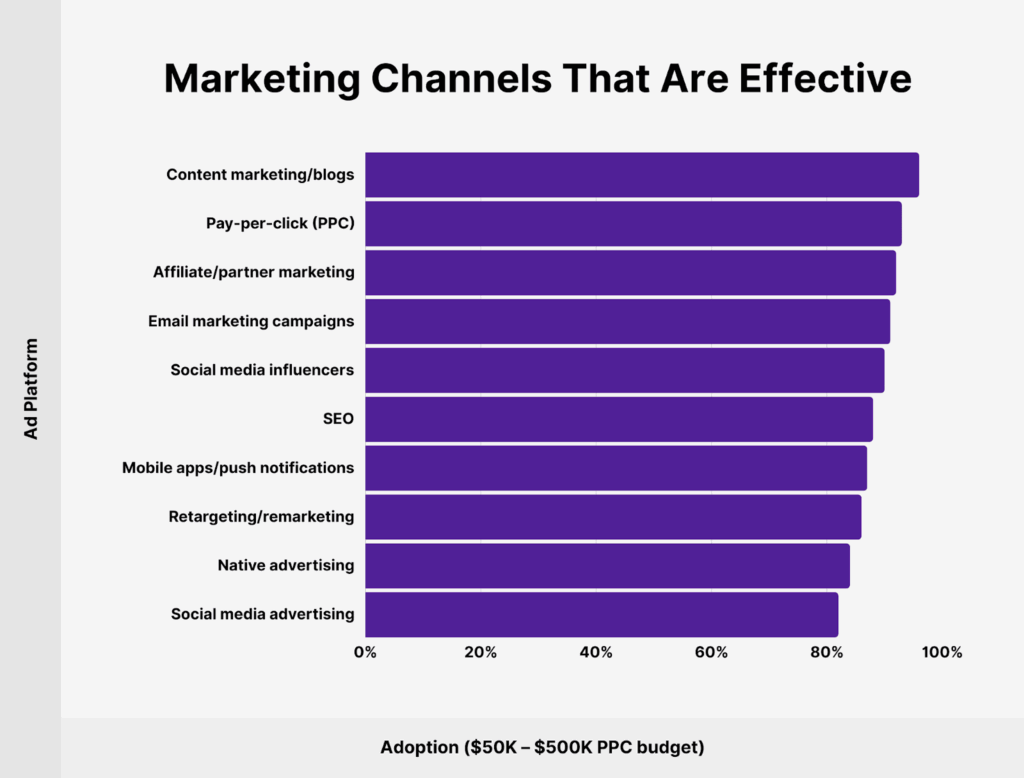
Source: Backlinko
Create systems for growth:
It becomes impossible to maintain a manual workflow while scaling a business from $1 million to $10 million. This calls for the creation of more automated systems, documented processes, and defined functions and duties. Such systems ensure fewer errors, better capacity, and stronger scaling opportunities.
Strengthen visibility with SEO:
A robust business plan for ecommerce brands includes provision for consistent SEO efforts, as every growth strategy cites online visibility as its primary goal. SEO is an important digital channel that small-scale businesses need to tap to rank on Google and drive people looking for products/services relevant to your business to your website.
You can go for professional ecommerce SEO services that include link building, technical SEO, content, and website maintenance for better visibility.
Drive quick results with PPC campaigns:
SEO is slow and offers a steady increase in visibility, which can be contrasted with the quick results from Pay-Per-Click (PPC) campaigns. Ads on either Google or social media can help you try new offers, acquire new customers, and generate revenue much sooner. The trick is to discipline and measure performance, start low, measure ROAS (Return On Ad Spend), and scale the business once you have consistent positive margins.
Get better reach with a social media presence:
Social media, of course, is more than just visibility; it is a way to build your brand’s voice and personality, which is an important part of your D2C business plan. Each social media channel serves a purpose: Instagram and Facebook are centred around storytelling; LinkedIn targets building trust and credibility, and YouTube provides an avenue to educate and engage.
The key to scaling a business is being steady with posting, sharing authentic stories, and encouraging customers to share their experiences. Social media marketing helps small entrepreneurs build relationships that extend beyond a single purchase. As always, remember that authentic engagement with your audience will always work better than pure advertising.
Bring back customers with retention marketing:
Retention is one of the most profitable avenues of your e-commerce business plan. It is much cheaper to sell to an existing customer than to acquire a new customer. Create simple retention flows with either email marketing, WhatsApp, or SMS, with a strong messaging flow to remind customers to reorder more quickly or personalised messages to thank them.
According to HubSpot, it is much easier to sell to an existing customer (60-70% chances) than to a new customer (5-20%). This makes it important to go for retention marketing if you want to scale up your business.
Improve website experience:
It is important to optimise your website to offer a good customer experience, as it is what your online storefront looks like. If the customers don’t like it, they wouldn’t bother revisiting. A questionable customer experience leads to them abandoning their carts, making it critical to keep navigation easy, offer fast and secure checkouts, and use clear product images.
According to Statista, an unpleasant website experience accounts for a majority of the cart abandonments.
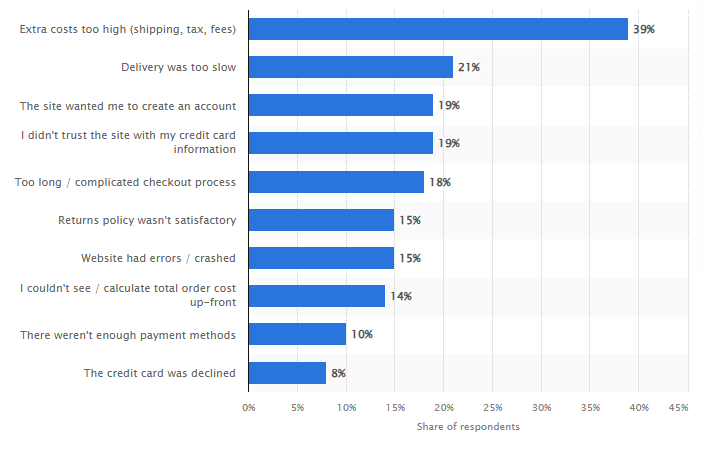
Source:Statista
Financial strategy for every small-scale business:
Balance growth with stability:
Rapid growth can be risky for any small-scale business if the finances are not stable. Along with the revenue, marketing, logistics, and labour expenses typically also increase. Balanced growth means adjusting for increased demand while also provisioning funds for volatile circumstances. Sustainably scaling a business refers to having consistent profit, not only sales revenue.
Reinvest with Proven Channels:
Not all of your marketing efforts bring in the same return on investment. Once you’ve determined what marketing channels work the best, put your resources toward them. While keeping the channel with the most return funded, you can keep testing new channels with low returns. Reinvesting in a proven marketing channel allows a larger return with fewer risks.
Leverage Partnerships and Expertise:
Sometimes, the right partner can do more to scale a business than any other marketing effort or campaign. You can work with vendors, consultants, and/or agencies who understand the challenges associated with scaling a business. Collaborations usually bring in new business perspectives and processes, which can save time, deliver knowledge, and develop business relationships with new customers.
Using digital tools & insights to grow your business:
Adopt smart tools and platforms:
As you scale up a business, keeping everything organised is important. There are many different tools that aid in client, team, and task management. For example, Notion, Trello or Zoho CRM are affordable platforms to help you streamline operations and cut down on costly errors. The intent is not to make your business heavily dependent on technology, but to scale the business more efficiently.
Track your metrics regularly:
Regularly track your numbers, such as ad budgets, website traffic, sales conversions, or repeat orders. These numbers will tell you what’s working well and what needs improvement. Establish a habit of reviewing data as part of your monthly business plan. Even simple analytics can give you compelling insights that will instruct your next steps.
Prioritise customer satisfaction:
The best marketing comes from happy customers, which makes it crucial to respond to all inquiries quickly and address any issues as they arise. No detail is too small because it adds up to building lasting trust; from the packaging quality to post-sale processes, each detail matters. Every exceptional experience adds to your brand and builds your repeat sales, helping scale the business.
Common mistakes small-scale businesses make while scaling:
Scaling without systems:
Too many small scale businesses rush into expanding before they have built any structure. This usually ends up with customers being unhappy because their orders are taking longer and teams getting frustrated and likely providing inconsistent service because of limited resources. This is why you should always strengthen your structure before you expand beyond it; in other words, simply stick to your D2C business plan without hurrying and making wrong decisions.
Not considering feedback and market shifts:
The needs of your customers and market are always changing. Ignoring market and customer shifts can be detrimental to your business. To understand the audience and the market better, you can conduct regular surveys, continuously read reviews and look at what competitors are doing so that you can constantly stay on top of customer needs.
Failing to delegate responsibilities:
When a small-scale business is growing to its $1 million mark, the founders might want to save up on finances and do all tasks themselves. However, as you grow your business beyond $1 million, it becomes increasingly difficult to do so. You need to build a trustworthy and expert team and delegate responsibilities for more efficient operations.
Final thoughts: Understanding why a strong business plan matters for scaling a small-scale business
Typically, for ecommerce brands, the road from $1 million to $10 million is not instantaneous; rather, it’s an ongoing process of improving, learning, and adjusting to changing conditions. Successful companies at this stage have a strong business plan and execution abilities, and are digitally ready. This builds a resilient foundation on which you can build by consistently showing up with a long-term and patient mindset.
Nethority offers proven strategies for growing small-scale businesses into 10x revenue-generating giants. Get in touch with us for professional marketing services.
FAQs
1. How can small-scale businesses create a digital roadmap for growth?
A: Start by defining goals for growth, improving your website, building a digital footprint by considering different marketing channels. A well-designed ecommerce business plan can keep you focused with measurable purpose and objectives.
2. What are common challenges faced while scaling a business online?
A: The most common challenges are managing operations, costs, delivering a quality service, and staying relevant in a competitive marketplace. Efficient planning can help you overcome these challenges smoothly.
3. What is the best way to scale a D2C business from 1M to 10M revenue?
A: The best way to scale a business is to refine your D2C business plan and then layer in digital growth strategies such as SEO, PPC, social media, and retention marketing while building and maintaining strong systems and managing your finances efficiently.
4. How important is SEO in a business plan for growth?
A: SEO is very important for consistent website traffic and improved visibility while at the same time driving buyers who actively engage in seeking your product or service online.
5. Can automation tools really help small-scale businesses grow faster?
A: Yes. Automation tools free up valuable time, reduce human error and help with an overall focus on strategy. They are simple to use and assist in marketing, communication, and associated operational efficiencies, which will allow you to scale with limited resources.
Author’s Bio:
Ruturaj Kohok is the Founder and CEO of Nethority, a digital growth agency that uses performance, innovation, and insight-driven strategy to enable brands to grow. Having worked in digital marketing and brand transformation for more than 15 years, he specialises in building lasting growth ecosystems that integrate data, technology, and corporate objectives.
Through his strategic leadership, Ruturaj has helped numerous startups, SMEs, and global enterprises achieve measurable growth (5x to 10x) by improving their digital presence, increasing lead generation, and driving higher ROI through performance-driven marketing.