
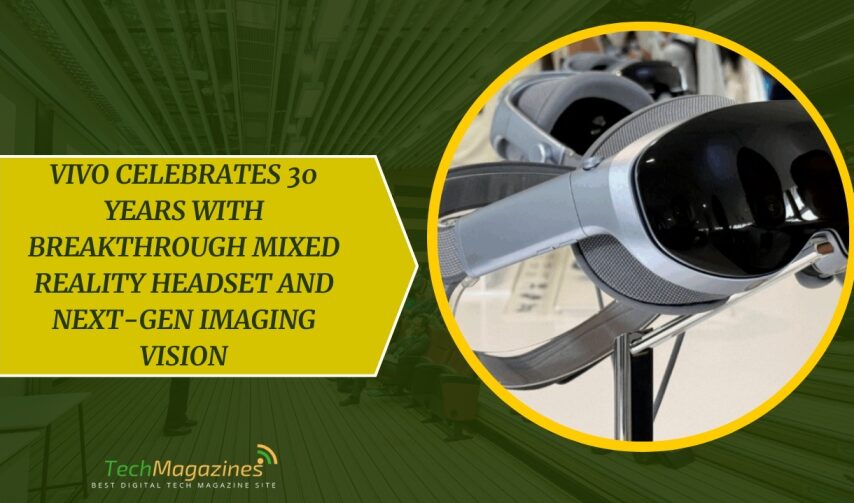

On August 21, 2025, in Dongguan, vivo observed its thirtieth anniversary with the Vision Launch Event and the Imaging Grand Ceremony. During the occasion, the firm presented its first mixed reality headset, named the vivo Vision Discovery Edition. This debut represents a turning point in vivo’s pursuit of spatial computing and immersive technologies.
Using its broad knowledge in imaging, sensors, and display systems, the company has taken deliberate steps to solve the hardest problems facing MR devices, chief among them perception, interaction, and computational power. The Vision Discovery Edition stands as the first MR device produced by a Chinese smartphone manufacturer, making vivo the first in the nation to operate in both the smartphone and MR domains.
At the same ceremony, vivo announced a complete revision of its imaging strategy and the cultural system built around it, and it also revealed the winners of the 2025 vivo VISION+ Mobile PhotoAwards.
Redefining Everyday Immersion with Vivo Vision Discovery Edition
Four years of work have gone into the making of Vivo Vision Discovery Edition. It joins the company’s technical progress with its habit of putting the user first, while pushing forward its plan for home robotics and carrying mixed reality out of the laboratory and into daily life. Built for constant use, the device is light and shaped for comfort. It weighs 398 grams, stands 83 millimetres high, and is 40 millimetres thick, which is about a quarter smaller than the common standard. This lessens the strain of wearing it. Its form is based on long studies of human needs and offers four kinds of light seal and eight foam pads, so that it sits well and stays easy even in long sessions or during movement.
The system runs on OriginOS Vision, which allows simple, natural control. Data appears as if it belonged in the space about you, so that the old habit of tapping on screens gives way to gestures made by hand. Its eye-tracking is accurate to 1.5 degrees, its gesture range covers twenty-six degrees of freedom, and its vertical range runs to 175 degrees. All this makes control easy and quick to learn. Two Micro-OLED screens give an 8K picture to both eyes, with wide colour range, high accuracy, and a sharpness near that of a cinema display. Each side is tuned for equal brightness and colour, keeping the gap in brightness under two nits and the colour error below ΔE of two, so that the eyes do not suffer from mismatch.
The vivo Vision Discovery Edition is built on the newest Qualcomm Snapdragon® XR2+ Gen 2 platform. In contrast to the model before it, this chip brings more than double the power to graphics and eightfold to AI, making possible a level of vision and control unknown until now. With such strength behind it, the headset can drive the fast, heavy work of spatial computing without strain.
It is made to stand as a clean doorway into the user’s digital world, taking in not only games and amusement but work as well. Its video fills the eye and lets one turn from any point, so that a match or an e-sports contest may be seen from every angle, or split to show two views at once, and no moment is lost. For films, it can cast a screen as wide as a small hall, one hundred and twenty feet across, so that a theatre is never farther away than the chair you sit in.
Vivo Reinvents Imaging with Future-Ready Ecosystem
On its thirtieth year, vivo set forth a full renewal of its imaging plan, aimed at joining scenes together and shaping a complete chain of imaging tools. The purpose is to build on its strength in night shots, portraits, long-range lenses, and video, while meeting the new demand for varied, setting-based uses. The fresh plan seeks to bring professional-level imaging within reach of more people, covering fields such as image security, health, and links across devices.
As the first Chinese phone brand to enter the Coalition for Content Provenance and Authenticity (C2PA), vivo pledges that all new features will guard the trust of content by making it both traceable and proven. In health, it means to blend the Telephoto Macro skill of the X200 line with clinical-grade optics to make a hand-held slit lamp, giving wider access to eye care. To add depth in making and viewing, vivo will also join devices with ease, from 3D imaging on the X100 Ultra and 60 fps spatial video on the X200 Ultra to the new Vision Discovery Edition.
vivo’s work with ZEISS has now entered a fresh stage. For five years, the two have combined vivo’s focus on the user with ZEISS’s strength in optics, setting new marks for what phone cameras can do. Under its renewed imaging plan, vivo will go on perfecting its own technology, pushing its skill further to bring new forms of use. Its leading VS1 pre-processing chip now works with the V3+ imaging chip to raise speed and quality in hard settings, holding fine lines in portraits and keeping light and detail even when brightness fails.
Advanced Camera Innovations Setting New Industry Standards
As the first maker to fit a 200-megapixel sensor in a telephoto lens, vivo has launched the BlueImage × Samsung HP9 sensor and the Blueprint × Sony LYT-828 sensor. With help from its large-model algorithms, such as AI Photo Enhance, these advances bring sharp, steady shots even at high zoom. Looking ahead, the firm will draw on tools for image repair and rebuild, along with next-stage models, to lift the detail and truth of its 30x telephoto reach.
For video, vivo has added tools like Multi-Focal 4K slow motion at 120 frames per second, 4K portrait effects, Live Photo Portrait, and AI Erase, showing the full strength of its end-to-end imaging system to seize life in clear and vivid form. It will keep adding film styles, such as Cool Tone Video Portrait, and will launch its own AI for Custom Beautification, so that young makers can shape their work as they choose.
Building a Global Culture of Imaging and Creativity
vivo is building an imaging culture that joins advanced tools with an open stage for creation, so that mobile photography may grow wider in reach and richer in form. It is seeking new ties with the young through efforts such as the Capture the Future short film contest with UNESCO, giving room for fresh voices in film, and the first National Mobile Photography Exhibition with the China Photographers Association, which aims to reshape how the public sees the art of the lens.
At this gathering, vivo named the winners of the 2025 vivo VISION+ Mobile PhotoAwards, which drew more than half a million entries from across the globe. All were taken on vivo phones, and they show plain moments of life and new ways of looking at the world we share.
With thirty years of craft behind it, vivo again makes clear its faith in user-first design, sound technology, and lasting partnerships, as it works to set the course for the next age of imaging.
Final Words
As vivo marks its 30th anniversary in the tech industry, it is apparent that the company is not looking to sit on its laurels, or its impressive camera sensors. The Vision Discovery Edition is basically a computer duct-taped to your face and they call it a revolution.
The actual news here is not another gadget launch, but a big bet by vivo that mixed reality will become as indispensable as smartphones. Their imaging experience coupled with spatial computing will place them at the nexus of a number of emerging technologies, a potentially lucrative but risky position.
It is yet to be seen whether consumers will be willing to adopt gesture controls over the tried and tested screen tapping. However, there is one thing that is certain: vivo is betting big that the future will be one where we spend less time looking at our phones and more time looking around at augmented worlds. Whether time will prove this vision to be reality or just another costly experiment that will be gathering dust in tech drawers across the world remains to be seen.