
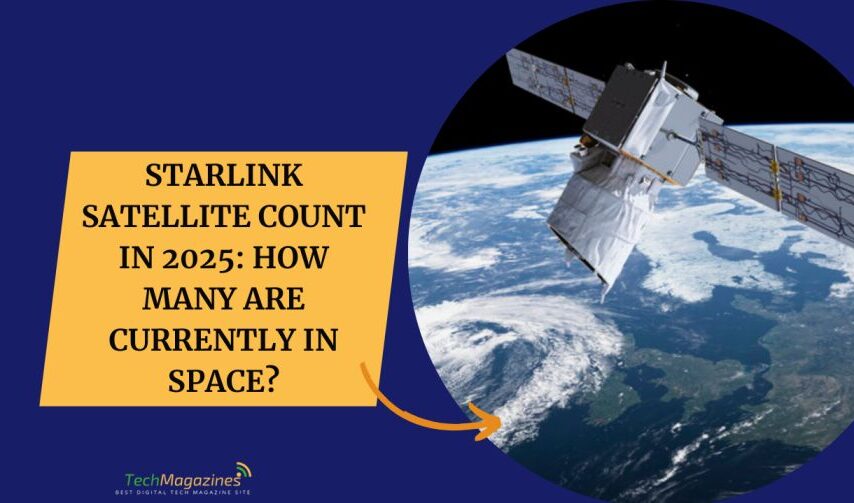

Most people have heard the name Starlink by now, but fewer understand what these satellites actually do, or how many of them are currently above us. The answer is simple in essence, though immense in scale. Starlink is an internet service built on a swarm of satellites that move in low-Earth orbit. Its purpose is to bring connection to those beyond the reach of cables and towers, whether in rural plains or distant mountains. Though the project is well underway, what exists so far is only the beginning.
Total Starlink Satellites in Space as of 2025
As of June 26, 2025, the Starlink network has grown to include 7,875 satellites (of which 7,855 are functional). The figure rises steadily, as new batches are launched month by month. For the moment, regulators have cleared the path for up to 15,000 satellites—already a formidable number. Yet even this is far from the end. Starlink’s ultimate plan is to place roughly 42,000 satellites into orbit, blanketing the globe with continuous internet coverage. Whether such a scheme proves visionary or excessive, it stands as one of the most ambitious efforts in the modern use of space.
Physical Design and Structure of Starlink Satellites
The Starlink satellites are small and rectangular with a flat body and weigh 573 pounds each. Four antennas in the centre transmit the internet signals to the ground. The power needed is provided by a broad solar panel which is folded with the main structure. The satellites talk to each other with lasers and connect with four neighbours simultaneously. They use small engines that are powered by krypton gas to move and correct their orbits.
Lifespan and Deorbiting of Starlink Satellites
The life of any satellite is short-lived. They are likely to last an average of five years. When a satellite has outlived its usefulness, it is slowly steered down the atmosphere where it is burns instead of being space junk.
Why Starlink Satellites Worry Astronomers
Several astronomers have expressed concerns about the existence of Starlink satellites. They are not against the project, but against the visibility of the satellites. The units are luminous and since they move fast against the night sky, they may disrupt long exposures made with telescopes. SpaceX attempted to mitigate the issue by applying darker paints, which caused the overheating. In more recent models, however, there is what is termed a sun visor, a small shield that prevents reflected sunlight, reducing the glare as viewed on earth.
Long-Term Impact: Are Starlink Satellites a Risk?
At present, the issue is not severe. It amounts to a minor nuisance, one that can be worked around. But the trouble lies ahead. Starlink’s long-term goal involves launching over 40,000 satellites, and it is not alone. Amazon has its own plans under the Kuiper name, and several smaller firms are pursuing similar aims. If all proceed as intended, we may one day see hundreds of thousands of satellites in low orbit.
That figure carries consequences. New designs may reduce the harm done to night-time observations, but the challenge is not only one of visibility. The greater threat is congestion. As the skies grow crowded, the chance of accidents rise and includes collisions, fragments, and loss of control. Even with improved tracking systems, it becomes harder to predict and prevent errors. The risk, then, is not merely aesthetic. It is practical, physical, and steadily growing.
Conclusion
There are thousands of satellites already whizzing over our heads, and tens of thousands more in the pipeline. The vision of Elon Musk to connect the world has turned into a cosmic game of chess, where each step is not only impacting internet users in the most remote corners of the planet, but also astronomers who are trying to explore the secrets of the universe. It is delicious irony, really. As we strive to get closer to the stars by improving connectivity, we may simply end up not seeing them at all.
It is like putting up street lights in a nature reserve, it is admittedly a good idea, but you can forget those beautiful night skies. Starlink may turn out to be a technological masterpiece of humanity or just another attempt to clutter space. At least one thing is sure: the night sky of the future will be nothing like the one our ancestors were used to.
FAQs
Q1: How many Starlink satellites are currently in orbit?
As of June 26, 2025, there are 7,875 Starlink satellites in Earth orbit, and another batch is launched every month on a regular basis. SpaceX is approved to have 15,000 satellites, although they want to go as high as 42,000. That is a lot of metal in the air to make even the most space-enthusiastic individual question whether we are going overboard with this whole connectivity issue.
Q2: What exactly do these satellites do?
Starlink satellites broadcast the internet down to the ground, especially in places where the cable and cell towers dare not go: the farmlands, the mountain cabins, and any place your provider thinks is too much trouble. They are basically floating Wi-Fi hotspots that don’t ask you to restart your router, but need a clear view of the sky and a hefty monthly subscription.
Q3: How big are Starlink satellites?
The satellites are 573 pounds and have a compact, rectangular shape. They have four antennas to beam internet signals back to the earth, solar panels to provide power and small krypton-powered engines to make orbital corrections.
Q4: How long do these satellites last?
Starlink satellites last approximately five years; that is, approximately as long as your typical smartphone contract, but with much more at stake. Once they are of retirement age they are intentionally brought back to earth where they burn in the atmosphere like costly shooting stars, so they do not become part of the space junking that is accumulating around our planet.
Q5: Why are astronomers upset about Starlink?
The satellites reflect the sunlight producing bright streaks that disrupt the deep-space observations. SpaceX experimented with darker paint, but the satellites became too hot, as black cars in summer. Their solution was to use small “sun visors.”