

For large enterprises managing complicated financial transactions across various departments and their customers, a systematic cash flow is important. Still, even some of the biggest enterprises struggle with delayed payments, inefficient follow-ups, and mounting Days Sales Outstanding (DSO). The challenge often lies not in a lack of discipline, but in outdated or manual collections processes that can’t keep pace with modern business complexity.
Fortunately, collections automation software has emerged as a data-driven solution that automates the accounts receivable (AR) workflow, accelerates cash conversion, and improves customer relationships. Beyond streamlining operations, the real power lies in its measurable return on investment (ROI): faster payments, reduced write-offs, and less operational stress for finance teams.
The Hidden Cost of Manual Collections
For large organizations, the scale of collection challenges is different from that in smaller firms. A large company processes thousands of invoices in different currencies, languages, and rules. It is easy to develop a habit of late payment when there is no automation, which can lead to cash flow problems.
Manual collections involve multiple friction points:
- Repetitive follow-ups across time zones and departments.
- Limited visibility into customer payment behavior.
- High administrative overhead and employee fatigue.
- Missed escalation timelines leading to write-offs or strained customer relations.
The result is not only slower cash flow but also hidden costs, lost productivity, poor forecasting accuracy, and employee burnout. In large organizations, these inefficiencies can translate into millions of dollars in opportunity costs annually.
How Collections Software Changes the Game
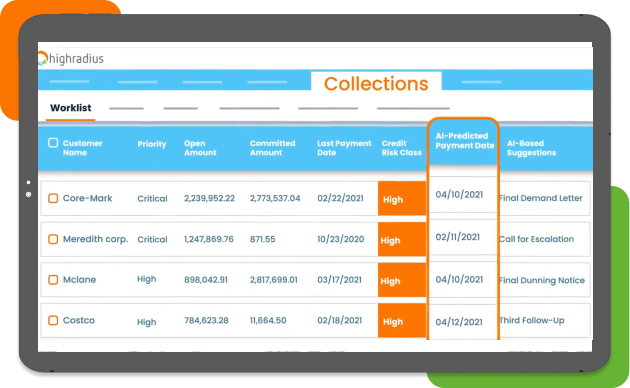
Modern collections software is designed specifically to accommodate the size and complexity of enterprise receivables. It connects to ERP and CRM systems, pulling information together into a single source. Using automation, AI, and predictive analytics, it shifts collections from a reactive task to a proactive cash management function.
Key capabilities include:
- Automated reminders and workflows: The software automatically prioritizes invoices based on risk, value, or customer profile.
- Real-time visibility: Dashboards provide instant cash flow visibility to CFOs and finance executives of your overdue accounts and collections performance.
- Data-driven predictions: AI-first models predict when customers will delay payment and trigger engagement beforehand.
- Collaboration tools: Teams across the organization, from sales to finance, can work together on accounts, communicating internally with shared notes and escalation workflows, eliminating silos.
For enterprises working with thousands of client accounts, they can automate their workflows and reduce manual effort by 50-70% giving time back to their employees to focus on strategy.
Measuring ROI: From Efficiency to Cash Flow Impact
The ROI of collections software goes beyond simple cost savings. It’s about transforming the balance sheet through measurable, quantifiable improvements.
Automated reminders, enhanced visibility, and structured escalation workflows improve collections cycles. Organizations report that they meet or improve their DSO by 10–25% in the first year of implementation. This is cash that was previously tied up in receivables for far too long, cash that is now available for reinvestment, acquisitions, or debt reduction.
Improved cash flow forecasting
Enterprises thrive on precision forecasting. Collections software integrates real-time payment behavior data into treasury models, improving forecast accuracy by 15–20%. That reliability allows for better capital planning, optimized credit terms, and stronger liquidity management.
Lower operational costs
Automation decreases the use of human labor, producing lower administrative costs, making the company less dependent on third-party collection. Long-term, the savings compound, particularly across many subsidiaries or business units.
Employee productivity and satisfaction
Finance professionals do not waste time issuing reminders or reconciling spreadsheets. Rather, they are focused on more valuable activities—credit strategy, analytics, and relationship management, all of which should drive better retention and morale in the finance team.
Strategic Value for Enterprises
For enterprise leaders, collections software is not just a tactical tool; it’s a strategic enabler.
Strengthening customer relationships
Automation doesn’t mean an impersonal service. It means using smart collection systems that ensure messaging is personalized using account history and tone. This means the client is being communicated with professionally. This keeps brand reputation intact while speeding collection.
Supporting global scalability
Multinational enterprises operate in a web of currencies, tax rules, and banking systems. Collections software adapts to these variations for compliance and consistent performance across global entities.
Enabling data-driven decisions
Collecting data is a goldmine of customer insight. It reveals which clients consistently delay payments, which sectors show early distress, and where terms need adjustment. CFOs can use this intelligence to refine credit policies and reduce risk exposure enterprise-wide.
The Bottom Line
For enterprises, investing in collections software is not an operational expense; it is a financial growth strategy. Faster payments mean more liquidity. Automation means less stress and fewer errors. And predictive analytics means greater foresight and control over the entire cash cycle.
The ROI is clear: quicker payments, fewer losses, and a finance team that doesn’t have to chase invoices but can help the enterprise grow strategically.