
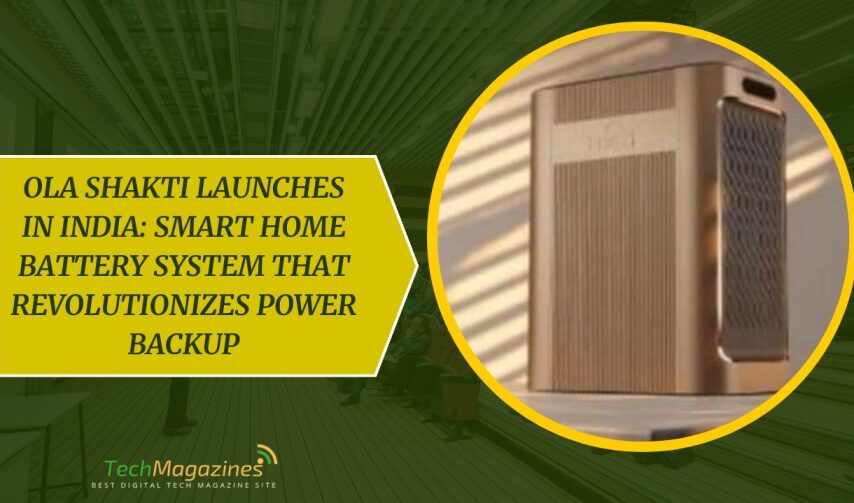

Ola Electric has ventured past its familiar ground of scooters. On October 16, the company introduced Ola Shakti, a household battery energy storage system that signals its entry into what CEO Bhavish Aggarwal describes as an Rs 1 lakh crore opportunity. The device is not quite an inverter, nor is it a simple power bank, though it borrows certain qualities from each.
Ola Shakti is what engineers call a battery energy storage system – a machine that holds electricity for later use. Unlike the common inverter, which serves mainly as a backup during blackouts, or the small power bank meant for gadgets, this system combines storage, control, and coordination with the power grid. It gathers energy from either the grid or solar panels and releases it when demand rises, when supply falters, or when the cost of power climbs. It represents a quiet step towards a more deliberate command over energy itself.
Ola Shakti Variants and Pricing
The product is offered in four sizes: 1.5 kWh at Rs 29,999, 3 kWh at Rs 55,999, 5.2 kWh at Rs 1,19,999, and 9.1 kWh at Rs 1,59,999. These are temporary rates, set for the first ten thousand buyers. Bookings have opened for Rs 999, and deliveries are planned for Makar Sankranti 2026. Bhavish Aggarwal described the launch as a deliberate broadening of Ola Electric’s purpose – the company, he reminded, was named with “Electric” rather than “Auto” to mark its larger intent.
The units will be built at Ola’s Gigafactory in Tamil Nadu, using the same 4680 Bharat Cells first designed for its scooters. This allows the firm to expand swiftly, without the burden of new investment or further research, drawing instead on its existing plants and its chain of four thousand outlets.
How Powerful Is Ola Shakti? From Homes to Farms
The system is strong enough to run heavy home equipment such as air conditioners, refrigerators, and induction stoves. It can also serve farms, powering water pumps, or small shops that depend on steady electricity. A full charge takes two hours, and the larger models can supply one and a half hours of power at full load.
The company claims an efficiency of up to 98%. What distinguishes Ola Shakti from the old inverter is not brute strength, but mind. Ordinary inverters give plain backup with little command; this one, by contrast, thinks as it works, adapting its power to the moment.
Smart Features that Make Ola Shakti Stand Out
Ola Shakti comes equipped with several thoughtful features. One of them is the Time of Day scheduler, which lets users store power when rates are low and draw from it when prices rise. It also includes an intelligent backup system that chooses which devices receive power first during a blackout, and remote diagnostic tools that update the software through the air. The unit can handle wide voltage swings, from 120 to 290 volts, shielding homes from erratic supply. Its batteries hold an IP67 rating, meaning they are sealed tight against dust and rain, built to endure the monsoon.
Complete Control Through the Ola App
The shift from grid to battery occurs instantly – in no measurable time – so lights never flicker, and machines keep running. Through a mobile app, users can track energy use, adjust settings, and see how efficiently their power is managed. Unlike the small power banks that charge phones and laptops, measured in milliamp hours, Ola Shakti works on a much grander scale. Even the smallest model of 1.5 kWh can run several household machines for hours.
The largest, at 9.1 kWh, can, as Aggarwal claims, sustain a two-storey house or a farmhouse for much of the day. The system’s modular form allows units to be linked together, scaling beyond 27 kWh if needed – enough to keep an entire cluster of homes alive through the dark.
Bhavish Aggarwal’s Vision: From EV Batteries to Energy Independence
Aggarwal chose to speak of energy storage, not energy shortage. He remarked that many had believed the Gigafactory would serve only the needs of electric vehicles, yet its greater purpose lay elsewhere – in storing power for the grid and for homes. According to him, the demand for such storage would soon overtake that for automobile batteries, with Ola’s annual use of BESS units expected to rise to five gigawatt-hours in the coming years.
The company intends to rely on its present web of service centres and dealers to distribute Ola Shakti, avoiding the cost of fresh infrastructure. For now, the focus is on households, but Aggarwal hinted that a version for factories, offices, and large-scale grid use is already in motion. He called it a “container grid” project – a heavier, industrial form of the same idea – which would make its appearance in due course.
A Step Toward Smarter, Self-Sufficient Power Use
Ola Shakti marks a change in the way homes and businesses might think about power. Instead of seeing electricity as something handed down by the grid, the system gives people the means to store it, govern it, and use it more wisely. For households fitted with solar panels, it captures the energy made under the sun and keeps it for the night. For others, it serves as both a guard against outages and a tool to save money by shifting use to cheaper hours. The idea borrows from the great battery systems that help steady national grids, matching supply with need.
By bringing such control to ordinary users, Ola is wagering that local energy storage will one day stand where the mobile phone stands in communication – a common, personal device that alters daily life. Yet the truth of that vision rests on harder facts: whether the machines endure, whether their cost stays fair, and whether the company can tend to thousands of them spread across towns, farms, and factories.
Conclusion
The move by Ola Electric to venture into home battery systems is a bold switch by the two-wheelers into managing power in the home. It is yet to be seen whether Ola Shakti will become the next necessity or will be covered with dust and left next to the discarded smart toasters. The company is definitely audacious, has the factory capacity and the typical confidence of Bhavish Aggarwal to make it happen.
The promise is a temptation to Indians fed up with power outages and electric bills that cost more than their rent. However, there is a huge gap between the introduction of a product and the maintenance of thousands of units in monsoons and voltage pandemonium. The actual test is the one that Ola will perform: will it be able to execute? When it does, energy storage becomes a luxury and not a necessity.
FAQs
Q1: How long does charging Ola Shakti take?
It takes about two hours to charge it fully- provided your grid supply is cooperative and the sun is cooperative if you have panels.
Q2: How much does Ola Shakti cost?
Ola has a price ladder which begins with the 1.5 kWh model priced at Rs 29,999 and the huge 9.1 kWh model priced at Rs 1,59,999. These promotional rates are a special offer that will not last long, the first ten thousand purchasers receive the lucky price.
Q3: How efficient is it?
Ola boasts of 98% efficiency, that is, only two percent of your electricity is wasted as heat. That is pretty fine.
Q4: Can I connect multiple units together?
Absolutely. The modular design of the system enables it to be stacked to more than 27 kWh. In theory, you would be able to connect enough units to supply an apartment building.